AI In BusinessAI Agents vs Chatbots for Sales Follow-up: Which One to Choose
The short answer
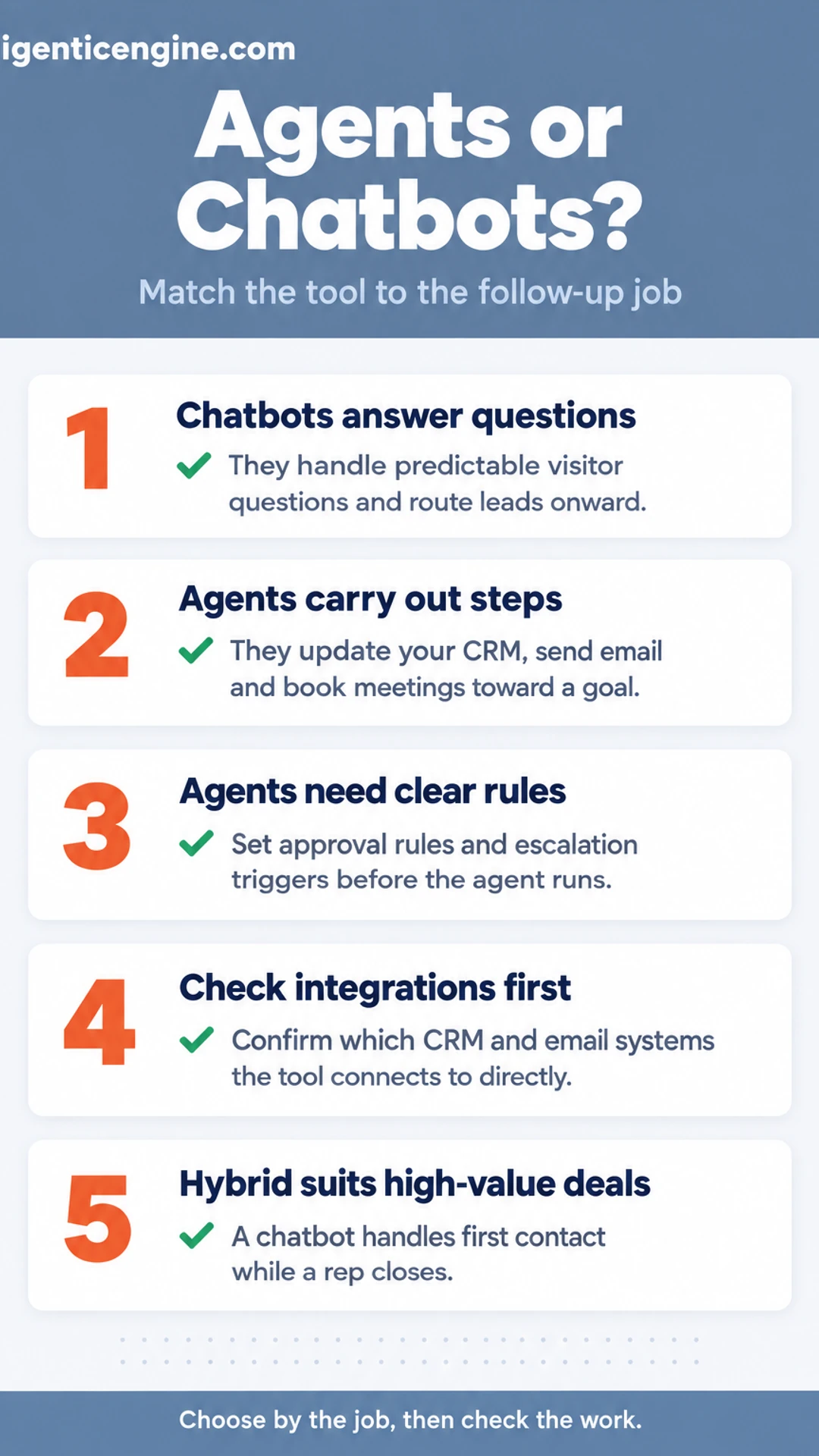
A chatbot answers questions through a conversation, usually from scripted flows or a knowledge base, and it typically cannot take actions in your other tools. An AI agent can reason through a goal, such as following up with a lead, and then carry out steps like updating your CRM, sending emails or booking a meeting. For most small sales teams, a chatbot suits website inquiries, and an agent suits multi-step follow-up, but the agent needs clear approval rules.
If you are trying to decide between the two, you are probably not short of tools. You are short of a clear way to tell which one will actually stop leads from going cold. Most of the marketing you have read blurs the two together, so the choice feels harder than it needs to be.
I think the useful question is not "which is smarter?" but "what job do I need done, and who checks the work?" Answer that and the right option usually becomes obvious.
This guide compares the two side by side, so you can see where each one fits your follow-up process. We will look at what each is best for, how much setup each typically needs, and which parts of the job they handle without help. Then we will walk through how to choose, and I will give you my own view on where small teams tend to go wrong. This guide is based on published specifications and what buyers report, not our own testing.
AI agents vs chatbots at a glance
| Option | Best for | Actions beyond chat | Setup and upkeep | Pricing model |
|---|---|---|---|---|
| Chatbots | Answering predictable visitor questions | Usually read-only, rarely writes | Quick launch, ongoing scripting | Per seat or per conversation |
| AI agents | Multi-step follow-up at volume | Updates CRM, sends email, books meetings | More upfront work: access, permissions, data | Per seat, per conversation or per task |
| Chatbot plus human rep | High-value deals needing judgment | Chatbot handles first contact only | Moderate; rep time required | Not stated |
What Each Option Actually Is
Before you compare anything, you need to know what you are comparing. The two terms get used interchangeably in product pages, and that makes shopping harder than it should be.
Chatbots are conversational tools. Some follow a fixed script of buttons and decision trees. Others use language models to hold a looser conversation. In both cases, the core job is to answer questions and route the visitor somewhere: to a help article, a booking page, or a human rep. Most chatbots are read-only in practice. They can tell a lead what your pricing is, but they usually cannot update the CRM, issue a discount, or book follow-ups on their own.
AI agents are built around a goal. You give one an outcome, such as "re-engage every lead who went quiet after a demo," and it works out the steps. That can mean reading the lead's history, drafting a message, sending it, logging the reply, and scheduling the next touch. The defining feature is that it takes multi-step actions across connected tools. Vendors often describe these as agentic systems, a term that refers to that goal-directed, action-taking behavior.
Why the terms get mixed up: many vendors label any AI-powered chat window an "agent," because the word sounds more capable. Some chatbots are now bolted onto workflow tools, which blurs the line further. When a product page uses either word, ask what the tool can actually do to your data and your systems. That answer tells you which category it belongs in.
The Differences That Matter for Sales Follow-Up
Most of the confusion between agents and chatbots comes down to what each one is allowed to do. The questions below are the ones I'd put to any vendor before you sign, because they separate a tool that talks from a tool that works your pipeline.
What can it actually do, beyond talking?
A chatbot mainly converses. It answers questions, qualifies a visitor and hands off. An agentic system is built to take actions: writing notes to your CRM, sending email, and checking or booking calendars. Published product materials from vendors in this space generally describe this action scope as the main dividing line, so ask for a list of the specific systems each one can write to, not just read from.
What happens when a reply goes off script?
- Check whether the tool escalates to a human on a defined trigger, such as a pricing objection, a complaint or a repeated non-answer.
- Ask how the escalation is handed over: does the rep get the full thread and the lead's history, or do they start from scratch?
- Confirm the rules are editable by you, not locked inside the vendor.
What does it take to set up and keep running?
Chatbots are often quicker to launch but need ongoing scripting as your offer changes. Agents usually need more upfront work: CRM access, permissions, and clean lead data. Decide early who owns the follow-up sequences, because a sequence nobody maintains quietly goes stale.
Which to Choose for Your Situation
The right choice usually comes down to three things: how many leads you handle, how complicated the follow-up needs to be, and what you want the tool to accomplish. Here is how each option tends to fit, based on published specifications and what buyers commonly report.
Chatbots fit when:
- Visitors arrive on your site with simple questions about pricing, hours or shipping
- You mainly need lead capture forms filled in and routed correctly
- Your follow-up volume is low enough that a person can review each conversation
A chatbot answers customers quickly and keeps them engaged at hours when your team is offline. For many small ecommerce shops, that alone recovers a meaningful share of lost interest.
AI agents fit when:
- You receive many leads and each one needs timed, multi-step follow-up
- You need the system to update your CRM as conversations progress
- You want follow-up sequences that adjust based on how a prospect responds
Agents are built to carry out tasks, not just reply. If you run a larger sales operation, this is where an agent earns its place.
A chatbot plus a human rep is often the better and cheaper choice when:
- Your deals are high-value and need personal judgment
- Your team is small and lead volume is moderate
- You want the chatbot to handle first contact while a person closes
This hybrid approach keeps costs contained, and a human stays responsible for the conversations that matter most. Start with what your current follow-up problem actually is, then match the tool to it.
What to Check Before You Buy
Before you compare features, check whether the product fits the tools you already run. A sales follow-up tool that cannot talk to your CRM or inbox will create more manual work, not less.
Confirm integrations with your CRM and email first. Ask the vendor which CRMs and email platforms they connect to directly, and whether that connection is native or built through a third-party connector. Ask what data flows in each direction. Shopify and other ecommerce stores matter here too, if your sales depend on shoppers and customers buying through your site.
Ask how actions are approved, logged and reversed. This is where agents and chatbots differ most. Find out:
- Which actions the system takes on its own, such as sending a follow-up email, and which need a human to approve them
- Whether every action is written to a log you can review
- How you undo a message or change that went out in error
Check the vendor's published pricing model. Pricing is usually per seat, per conversation or per task. Work out what your volume looks like each month and ask for an example bill based on it. Chatbots priced per conversation can cost more than expected at high traffic, while per-seat pricing can be cheap until you add users.
Keep a short list of questions for every vendor you consider. Their answers will usually tell you more than the feature page does.
What Vendor Claims and Buyer Reports Say
When you compare AI agents vs chatbots for sales, the performance numbers you see first are often the least reliable. Vendors publish conversion claims because they sell well, but a headline figure means little until you can see how it was measured. Before you weigh any number, ask a few plain questions.
- What counted as a conversion? A booked call, a reply, and a closed sale are very different outcomes.
- Who was in the sample? Traffic from a warm list converts differently than cold inbound questions.
- What was the comparison group? A lift measured against no follow-up at all says little about the alternative you would actually use.
- How long did the test run? Short windows can make early spikes look permanent.
Third-party roundups of AI chat conversion statistics are no better unless they name the original study and its sample. If a figure has no named source you can check, treat it as a rough guess, not a benchmark.
Buyers who have run these tools tend to report something less glamorous: results depend heavily on lead quality and follow-up speed. A well-timed reply to a qualified prospect usually matters more than whether a bot or an agent sent it. Plan your evaluation around your own leads and your own response times, and let your own numbers decide.
Our Take
Start with the follow-up job you most need done, not the label. Plenty of teams shop for an "AI agent" or a "chatbot" before they have decided what the work actually is. Write down the specific step you want handled, such as answering a question from a shopper after they browse your product page, or sending a second message to a lead who went quiet. Then ask which option fits that step. A chatbot is often enough when the job is answering a predictable question. An agent makes more sense when the follow-up needs several steps, such as checking inventory, updating your CRM and deciding when a human should step in.
Give an agent write access only after you trust its approval steps. Reading data is low risk. Sending messages, changing deal stages or issuing discounts is where mistakes cost you money or customer goodwill. Start with the agent drafting actions for review, watch the results for a few weeks, and widen its permissions only as the record holds up.
Revisit the decision once your lead volume and CRM setup are clearer. Small businesses often pick a tool before their pipeline data is clean. If your contacts are duplicated or your deal stages are inconsistent, neither option will perform well. Once those basics are in order and you can see how many customers reach you each month, the right answer is usually easier to spot.
Frequently asked questions
Is selling AI agents profitable?
It can be, but margins depend on the buyer's problem, how much customization the sale needs, and how much ongoing support follows. Resellers who attach setup, integration and monitoring to a clear outcome tend to earn more than those selling a generic tool with no service around it.
Are AI agents the same as chatbots?
No. A chatbot mainly answers questions within a conversation. An AI agent can take multi-step actions on its own, such as checking a CRM record, deciding the next follow-up, sending a message and logging the result. Many products blur this line, so ask what the system does without a person prompting each step.
Which AI is best for salespeople?
The best option depends on the task. For drafting outreach emails and summarizing call notes, a general AI assistant works well. For repeatable follow-up across many leads, a workflow tool that connects to your CRM is usually the better fit. Start with the task that takes the most time each week.
Can AI agents do sales?
AI agents can handle parts of the sales process, such as following up with leads, qualifying them against set criteria and booking meetings. Closing complex deals, handling pricing negotiations and building trust with decision makers still generally needs a human. Most businesses get the best results by assigning the agent the routine steps and keeping people on the rest.
Should a small business use a chatbot or an AI agent for sales follow-up?
If you mainly need instant answers to website visitors, a chatbot is simpler and cheaper to set up. If you need follow-up sequences that run across days or weeks and update your CRM, an AI agent is the better match. Check what each vendor says the product does on its own before you buy.
Wrapping up
Chatbots answer questions. AI agents carry out follow-up steps, which is what most sales teams are short on.
Match the tool to the job: conversation for visitors, action for leads you already have.
Before buying, ask the vendor which steps run without a person and how results get logged.
What follow-up step is costing your team the most time right now? Tell us in the comments.
Share this: X · LinkedIn · Facebook
Summarize with AI: ChatGPT · Claude · Perplexity